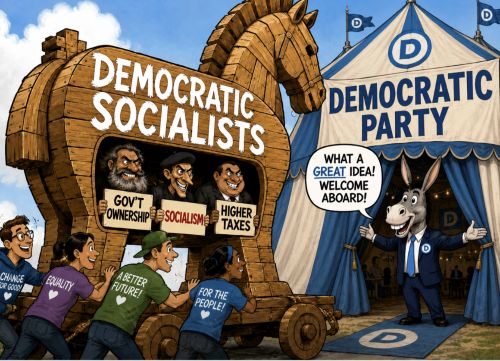
In an era when “all politics is local” is getting crushed by radical national forces, the Democratic Party is lurching hard left into the arms of its socialist wing.

We expose how this reckless transformation—from pretend pragmatism to full-blown democratic socialism—is wrecking America’s biggest cities and now knocking on Connecticut's door, and why it’s a five-alarm wake-up call for every freedom-loving citizen to fight for limited government, individual liberty, and the free enterprise that made this country great.
Former House Speaker Tip O'Neill famously observed that "all politics is local," meaning that voters care most about how government affects their families, livelihoods, and communities.
That remains true. Yet events unfolding far beyond Greenwich increasingly shape the choices confronting local voters. Nowhere is that more evident than within today's Democrat Party.
|
This is call to action for all Republicans and other like-minded citizens. |
For much of the post-war era, Republicans and Democrats generally agreed on the fundamentals of a market economy and individual opportunity. Their disagreements centered primarily on the appropriate size and scope of government. Republicans generally favored a more limited government and lower taxes; Democrats generally supported a larger governmental role in pursuing economic and social objectives.
Today, that traditional divide appears to be changing and widening.
America's three largest cities—New York, Chicago, and Los Angeles—are led by Democratic mayors who identify with or have been strongly supported by the party's progressive wing. In New York City, several Democratic Socialist-backed candidates recently won Democratic primary elections for Congress and are widely viewed as strong favorites in the general election.
Connecticut may be experiencing a similar dynamic. Governor Ned Lamont, generally viewed as a pragmatic Democrat, now faces a primary challenge from Democratic Socialist Josh Elliott. Meanwhile, the Democrat supermajority in the General Assembly has often pursued policies that place the Governor in a more centrist position within his own party.
Whether one welcomes these developments or not, they reflect a growing influence of the Democrat Party's progressive left.
Its advocates generally favor a substantially larger role for government through higher taxes, expanded regulation, housing mandates, rent controls, and broader redistribution of income. They also tend to oppose school choice and are often sharply critical of many long-standing institutions. To supporters, these policies promote fairness and social justice; to critics, they represent a significant movement toward Democratic Socialism.
The timing is striking. As America celebrates the 250th anniversary of its founding—a nation built upon limited government, individual liberty, and free enterprise—the country's political debate is increasingly focused on whether those principles should be substantially redefined.